
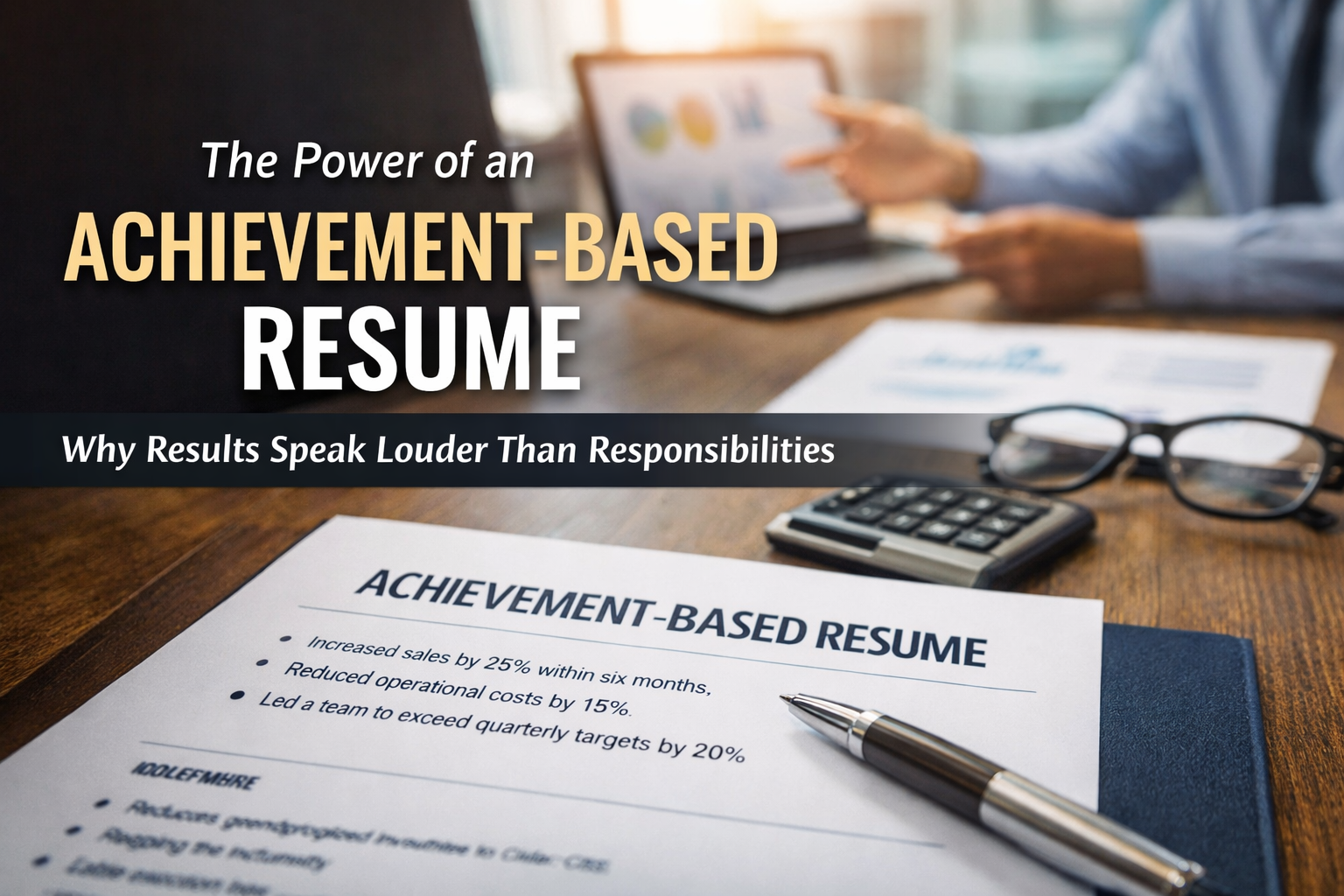
Why Results Speak Louder Than Responsibilities
In today’s competitive job market, listing job duties is no longer enough to stand out. Recruiters and hiring managers are looking for proof of impact, not generic descriptions of responsibilities. An achievement-based resume shifts the focus from what you were assigned to do to what you actually accomplished. This approach helps candidates clearly communicate value, performance, and relevance in a way modern hiring teams expect.
What Is an Achievement-Based Resume?
An achievement-based resume focuses on outcomes, results, and measurable impact rather than simply listing job responsibilities. Instead of describing what a role required, it explains how the professional contributed to business goals, solved problems, or improved performance.
Traditional resumes often read like job descriptions, which makes it difficult for recruiters to distinguish one candidate from another. Achievement-based resumes, on the other hand, tell a performance story. For example, replacing “Managed client accounts” with “Managed 25 client accounts, increasing retention by 18% year over year” instantly demonstrates value.
This approach is especially effective in competitive industries, ATS-driven hiring processes, and roles where performance metrics and results matter.
Why Do Recruiters Prefer Achievement-Based Resumes?
Recruiters favor achievement-based resumes because they communicate value quickly and clearly. With limited time to review each application, recruiters need to understand impact at a glance. Results-oriented statements make that possible.
At Expert Recruiting, we consistently see that resumes built around achievements receive more recruiter engagement and stronger interview conversion rates. Hiring managers want candidates who demonstrate problem-solving ability, ownership, and results, not just familiarity with tasks.
An achievement-based resume reduces ambiguity and builds confidence in a candidate’s ability to perform in the role.
How Do Achievements Improve ATS and Search Visibility?
Achievement-based resumes naturally perform better in Applicant Tracking Systems because they include high-value keywords in meaningful context. ATS software evaluates more than job titles. It scans for skills, tools, outcomes, and relevance to the role.
When candidates describe achievements, they often include action verbs, technologies, metrics, and industry terminology that align closely with job descriptions. Phrases such as “increased revenue,” “reduced operational costs,” “improved efficiency,” or “optimized processes” help resumes rank higher in ATS searches.
This structure also benefits AI-driven screening tools and SEO-based resume databases, which prioritize contextual relevance and demonstrated impact.
What Makes a Strong Achievement Statement?
A strong achievement statement clearly communicates action, result, and business impact. While metrics are ideal, clarity and relevance are equally important. Even estimated results are more effective than vague descriptions.
For example, “Led a sales team” provides little insight into performance. In contrast, “Led a six-person sales team that exceeded quarterly targets by 22%” immediately communicates leadership, scale, and success.
At Expert Recruiting, we help candidates refine their achievements to align with employer priorities such as growth, efficiency, revenue generation, risk reduction, or customer satisfaction.
Is an Achievement-Based Resume Only for Senior Professionals?
Achievement-based resumes are effective at every career stage, including entry-level and early-career professionals. Achievements are not limited to executive roles. They exist in internships, academic projects, freelance work, part-time roles, and volunteer experiences.
For example, a junior professional may shift from “Assisted with marketing campaigns” to “Assisted with digital marketing campaigns that increased engagement by 30% over three months.” The role stays the same, but the perceived value changes significantly.
This approach allows less-experienced candidates to compete more effectively by highlighting contribution, initiative, and results.
How Does an Achievement-Based Resume Support Long-Term Career Growth?
An achievement-based resume positions a professional as a high-impact contributor rather than a task executor. This distinction is critical for career advancement, leadership roles, and compensation growth.
By consistently framing experience around results, candidates reinforce a narrative of accountability and performance. This also prepares them for behavioral and performance-based interviews, where employers ask for concrete examples of impact.
Many professionals working with Expert Recruiting find that rewriting their resumes around achievements not only improves their job search outcomes but also clarifies their personal career story and strengths.
Conclusion: Results Change the Conversation
An achievement-based resume does more than improve formatting. It changes how recruiters, hiring managers, and automated systems perceive your value. By focusing on results instead of responsibilities, you position yourself as a professional who delivers impact and drives outcomes.
If you want support transforming your resume into a results-driven, achievement-focused document, connect with Expert Recruiting. Our team specializes in helping professionals at every level stand out with resumes that reflect real value, performance, and career potential.