27Dec

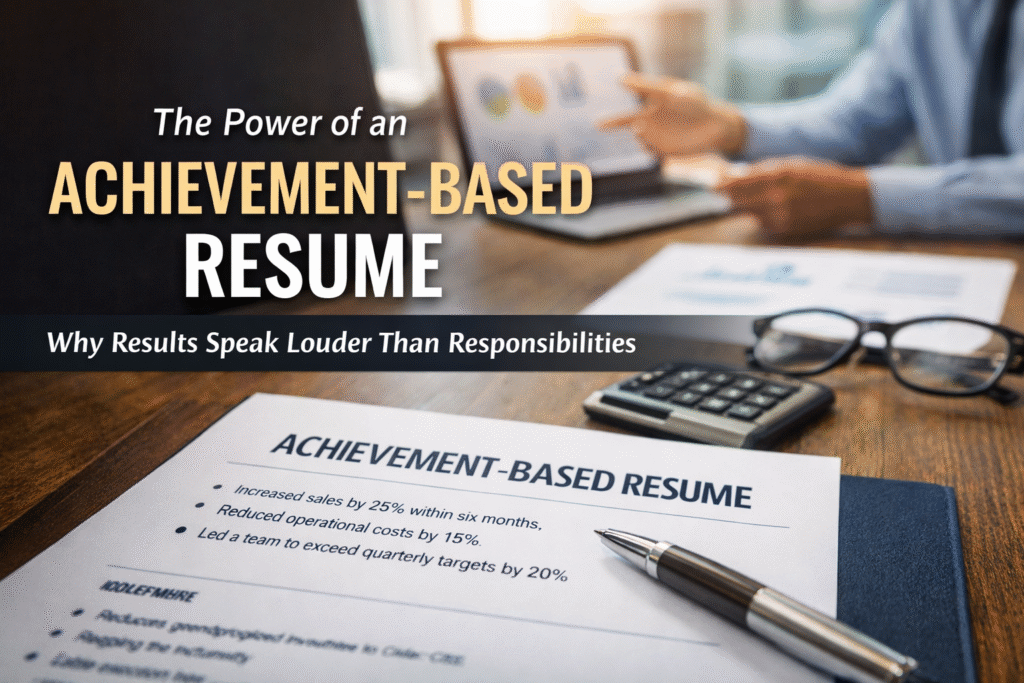
The Power of an Achievement-Based Resume

Why Results Speak Louder Than Responsibilities

In today’s competitive job market, listing job duties is no longer enough to stand out. Recruiters and hiring managers are looking for proof of impact, not generic descriptions of responsibilities. An achievement-based resume shifts the focus from what you were assigned to do to what you actually accomplished. This approach helps candidates clearly communicate value, performance, and relevance in a way modern hiring teams expect.

What Is an Achievement-Based Resume?

An achievement-based resume focuses on outcomes, results, and measurable impact rather than simply listing job responsibilities. Instead of describing what a role required, it explains how the professional contributed to business goals, solved problems, or improved performance.

Traditional resumes often read like job descriptions, which makes it difficult for recruiters to distinguish one candidate from another. Achievement-based resumes, on the other hand, tell a performance story. For example, replacing “Managed client accounts” with “Managed 25 client accounts, increasing retention by 18% year over year” instantly demonstrates value.

This approach is especially effective in competitive industries, ATS-driven hiring processes, and roles where performance metrics and results matter.

Why Do Recruiters Prefer Achievement-Based Resumes?

Recruiters favor achievement-based resumes because they communicate value quickly and clearly. With limited time to review each application, recruiters need to understand impact at a glance. Results-oriented statements make that possible.

At Expert Recruiting, we consistently see that resumes built around achievements receive more recruiter engagement and stronger interview conversion rates. Hiring managers want candidates who demonstrate problem-solving ability, ownership, and results, not just familiarity with tasks.

An achievement-based resume reduces ambiguity and builds confidence in a candidate’s ability to perform in the role.

How Do Achievements Improve ATS and Search Visibility?

Achievement-based resumes naturally perform better in Applicant Tracking Systems because they include high-value keywords in meaningful context. ATS software evaluates more than job titles. It scans for skills, tools, outcomes, and relevance to the role.

When candidates describe achievements, they often include action verbs, technologies, metrics, and industry terminology that align closely with job descriptions. Phrases such as “increased revenue,” “reduced operational costs,” “improved efficiency,” or “optimized processes” help resumes rank higher in ATS searches.

This structure also benefits AI-driven screening tools and SEO-based resume databases, which prioritize contextual relevance and demonstrated impact.

What Makes a Strong Achievement Statement?

A strong achievement statement clearly communicates action, result, and business impact. While metrics are ideal, clarity and relevance are equally important. Even estimated results are more effective than vague descriptions.

For example, “Led a sales team” provides little insight into performance. In contrast, “Led a six-person sales team that exceeded quarterly targets by 22%” immediately communicates leadership, scale, and success.

At Expert Recruiting, we help candidates refine their achievements to align with employer priorities such as growth, efficiency, revenue generation, risk reduction, or customer satisfaction.

Is an Achievement-Based Resume Only for Senior Professionals?

Achievement-based resumes are effective at every career stage, including entry-level and early-career professionals. Achievements are not limited to executive roles. They exist in internships, academic projects, freelance work, part-time roles, and volunteer experiences.

For example, a junior professional may shift from “Assisted with marketing campaigns” to “Assisted with digital marketing campaigns that increased engagement by 30% over three months.” The role stays the same, but the perceived value changes significantly.

This approach allows less-experienced candidates to compete more effectively by highlighting contribution, initiative, and results.

How Does an Achievement-Based Resume Support Long-Term Career Growth?

An achievement-based resume positions a professional as a high-impact contributor rather than a task executor. This distinction is critical for career advancement, leadership roles, and compensation growth.

By consistently framing experience around results, candidates reinforce a narrative of accountability and performance. This also prepares them for behavioral and performance-based interviews, where employers ask for concrete examples of impact.

Many professionals working with Expert Recruiting find that rewriting their resumes around achievements not only improves their job search outcomes but also clarifies their personal career story and strengths.

Conclusion: Results Change the Conversation

An achievement-based resume does more than improve formatting. It changes how recruiters, hiring managers, and automated systems perceive your value. By focusing on results instead of responsibilities, you position yourself as a professional who delivers impact and drives outcomes.

If you want support transforming your resume into a results-driven, achievement-focused document, connect with Expert Recruiting. Our team specializes in helping professionals at every level stand out with resumes that reflect real value, performance, and career potential.


23Oct

The Most In-Demand Soft Skills in 2025 – How to Identify and Highlight Yours

In 2025, the job market continues to evolve faster than ever — driven by artificial intelligence, remote collaboration, and global competition. Employers are no longer just looking for technical expertise; they’re prioritizing soft skills that ensure adaptability, leadership, and effective communication in hybrid work environments. Whether you’re a job seeker or a hiring manager, understanding which soft skills matter most can set you apart.

What are the most in-demand soft skills in 2025?

The top soft skills in 2025 include emotional intelligence, adaptability, critical thinking, communication, collaboration, and growth mindset. These qualities enable professionals to navigate uncertainty, work effectively across cultures, and leverage AI tools strategically.

In today’s fast-changing world of work, companies want talent that can think beyond tasks — people who build trust, lead with empathy, and solve problems creatively. At Expert Recruiting, we see these traits consistently ranked as top priorities across industries, from tech and logistics to healthcare and finance.

Why do employers value soft skills more than ever?

Because automation is handling more technical tasks, employers now depend on people who can lead, innovate, and build human connections — things machines can’t replicate. Soft skills amplify the impact of technical ability.

For example, two candidates may have similar credentials in data analysis, but the one who can clearly communicate insights, manage feedback, and adapt to new priorities will outperform in leadership potential. Recruiters at Expert Recruiting often emphasize that hiring for attitude and soft skills leads to longer employee retention and stronger team culture.

How can I identify my strongest soft skills?

Start by reflecting on how you handle challenges, feedback, and collaboration. Think of moments when you solved a conflict, learned quickly under pressure, or helped a team succeed. Then, ask peers or supervisors for feedback to confirm patterns.

You can also take personality or career assessments (such as CliftonStrengths or DISC) to pinpoint your natural tendencies. Combine this self-awareness with real-world examples — recruiters love when candidates can back up their strengths with stories that show impact, not just adjectives.

What are effective ways to showcase soft skills on a resume or LinkedIn profile?

Use measurable examples and action-driven language. Instead of simply listing “communication” or “leadership,” describe how you used them:

“Led weekly cross-functional meetings improving project delivery speed by 20%.”

“Resolved client escalations with empathy, increasing satisfaction scores by 15%.”

Also, update your LinkedIn “About” section with short, authentic stories that reflect your personality and growth mindset. Expert Recruiting recommends weaving soft skills naturally into your achievements, rather than isolating them in a generic list.

How can I demonstrate soft skills during an interview?

Employers look for authenticity and emotional awareness. Use the STAR method (Situation, Task, Action, Result) to structure your answers — it keeps you concise and focused on real impact.

For instance, if asked about teamwork, share a story that reveals both collaboration and adaptability. Non-verbal communication matters too: maintaining eye contact, active listening, and responding thoughtfully all reinforce your interpersonal strengths. Practicing mock interviews or recording yourself can help refine your delivery and presence.

Are some soft skills industry-specific?

Yes — while emotional intelligence and communication are universal, each industry highlights certain nuances.

Tech and engineering: adaptability, creativity, and cross-functional collaboration.

Healthcare: empathy, resilience, and active listening.

Logistics and operations: problem-solving and stress management.

Marketing and HR: storytelling, persuasion, and relationship-building.

At Expert Recruiting, we tailor candidate coaching to align these skills with each sector’s expectations, ensuring every professional presents the most relevant version of themselves to hiring managers.

How can I keep improving my soft skills over time?

Treat soft skills like muscles — they grow with deliberate practice. Engage in team projects, seek mentorship, volunteer in leadership roles, and request feedback regularly. Stay curious and reflect after each major work experience: What did I learn about myself and others?

Continuous learning, emotional regulation, and openness to change are the foundations of professional longevity. In 2025, lifelong learners — not just technical experts — are leading the future of work.

Conclusion: Your soft skills are your strongest career currency

In a world where technology evolves daily, your ability to connect, adapt, and inspire remains your greatest competitive advantage. Whether you’re pursuing a promotion or a new opportunity, now is the perfect time to elevate your soft skills and showcase them with intention.

👉 Connect with Expert Recruiting

 to discover how our team can help you identify, articulate, and position your strengths for the roles that fit you best. Your next career leap could begin with one powerful conversation.

03Oct

How to Reduce Time-to-Hire Without Sacrificing Quality – Practical Strategies with Tech and Process.

Hiring top talent faster is one of the biggest challenges for today’s HR leaders. Extended hiring cycles can lead to lost productivity, frustrated candidates, and missed opportunities. On the other hand, rushing the process risks poor hires that cost time and money. The solution lies in finding the right balance: reducing time-to-hire without compromising candidate quality. Below, we’ve gathered the most frequently asked questions on this topic, with practical strategies you can apply today.

Why is reducing time-to-hire so important for businesses today?

Time-to-hire directly impacts business performance, candidate experience, and employer brand. Faster hiring means less disruption, lower costs, and a competitive advantage in attracting top talent.

In today’s fast-moving job market, skilled candidates are often off the market within 10–15 days. A slow recruitment process not only increases the risk of losing these candidates to competitors but also creates inefficiencies in operations. Additionally, a drawn-out hiring experience can harm your reputation as an employer. Streamlining the hiring timeline signals that your organization values candidates’ time and is decisive, which strengthens your employer brand.

How can technology help speed up recruitment without lowering quality?

Tools like AI-powered screening, applicant tracking systems (ATS), and automated interview scheduling remove bottlenecks, freeing recruiters to focus on deeper candidate evaluation.

Technology is no longer optional—it’s essential. AI-powered platforms like RecruitGPT.ai (used by Expert Recruiting) help quickly analyze resumes, match candidates to role requirements, and highlight the best-fit applicants. Automated scheduling tools eliminate endless email back-and-forth, while video interviews allow faster initial assessments across time zones. By integrating these solutions, companies can reduce administrative tasks, accelerate decision-making, and ensure recruiters spend more time on meaningful conversations with candidates.

What role does process optimization play in reducing time-to-hire?

Even the best tech won’t help if the hiring process itself is inefficient. Clear workflows, well-defined roles, and structured communication are key.

Many delays occur not from lack of candidates but from unclear steps in the hiring funnel. Organizations should map their hiring process, identify bottlenecks (such as long approval chains or redundant interviews), and eliminate unnecessary steps. For example, replacing three separate interview rounds with a panel interview can cut weeks from the timeline. At Expert Recruiting, we often advise clients to set service-level agreements (SLAs) for each stage, ensuring that hiring managers and recruiters work in sync with defined turnaround times.

How do you balance speed with quality when hiring?

The key is combining data-driven insights with human judgment—screen fast, but validate carefully.

Speed and quality don’t have to be at odds. Recruiters can use structured scoring rubrics, behavioral interview frameworks, and standardized skills assessments to ensure consistency and fairness. Data from previous successful hires can also inform decisions, helping to identify which candidate traits predict success. Expert Recruiting emphasizes a “tech + human” model, where AI speeds up the initial process but final decisions are always guided by experienced recruiters who evaluate cultural fit and long-term potential.

What are some quick wins to shorten the hiring process right now?

Simplify your job postings, pre-screen effectively, and use technology for admin-heavy steps like scheduling.

Sometimes small adjustments make a big impact. Start with job descriptions—clear, specific postings attract better candidates faster, reducing wasted interviews. Next, implement short pre-screening questionnaires or skills tests to filter out unqualified applicants early. Finally, adopt calendar-syncing tools for instant interview scheduling. Together, these simple changes can shave days (or even weeks) off your time-to-hire without requiring a full system overhaul.

How can employers improve candidate experience while hiring faster?

Transparent communication, timely feedback, and respectful interactions keep candidates engaged even in a faster process.

Candidates are more likely to accept an offer—and recommend your company—when they feel valued. Provide realistic timelines upfront, communicate next steps clearly, and give feedback quickly. Even if a candidate isn’t selected, a thoughtful follow-up preserves your reputation and widens your talent pool for future roles. By combining efficiency with empathy, you ensure that speed never comes at the cost of professionalism or candidate trust.

Should companies outsource recruiting to reduce time-to-hire?

For many organizations, partnering with a recruitment firm is the fastest way to access qualified candidates without stretching internal resources.

Outsourcing recruitment brings specialized expertise, broader networks, and proven processes to the table. Firms like Expert Recruiting combine AI-driven tools with experienced recruiters to deliver both speed and quality. Instead of starting from scratch, employers tap into pre-vetted talent pools and structured workflows, dramatically cutting hiring times. This model is particularly effective for roles that are urgent, high-volume, or highly specialized.

Conclusion: Faster Hiring, Smarter Hiring

Reducing time-to-hire without sacrificing quality requires a mix of the right technology, streamlined processes, and a candidate-first mindset. The payoff is significant: lower costs, happier candidates, and stronger business performance.

At Expert Recruiting, we specialize in helping companies achieve exactly this balance. Whether through AI-powered tools, process optimization, or direct recruiting support, we ensure you hire faster and smarter.